AI-POWERED INDUSTRIAL SAFETY PLATFORM
Protect workers
before they know
they are in danger.
Guardian OS™ combines predictive artificial intelligence, biometric intelligence, and real-time operational monitoring to identify industrial risks before incidents occur.
24/7
Real-Time Monitoring
AI
Predictive Intelligence
98%
targeting 98%+ in pilot environments
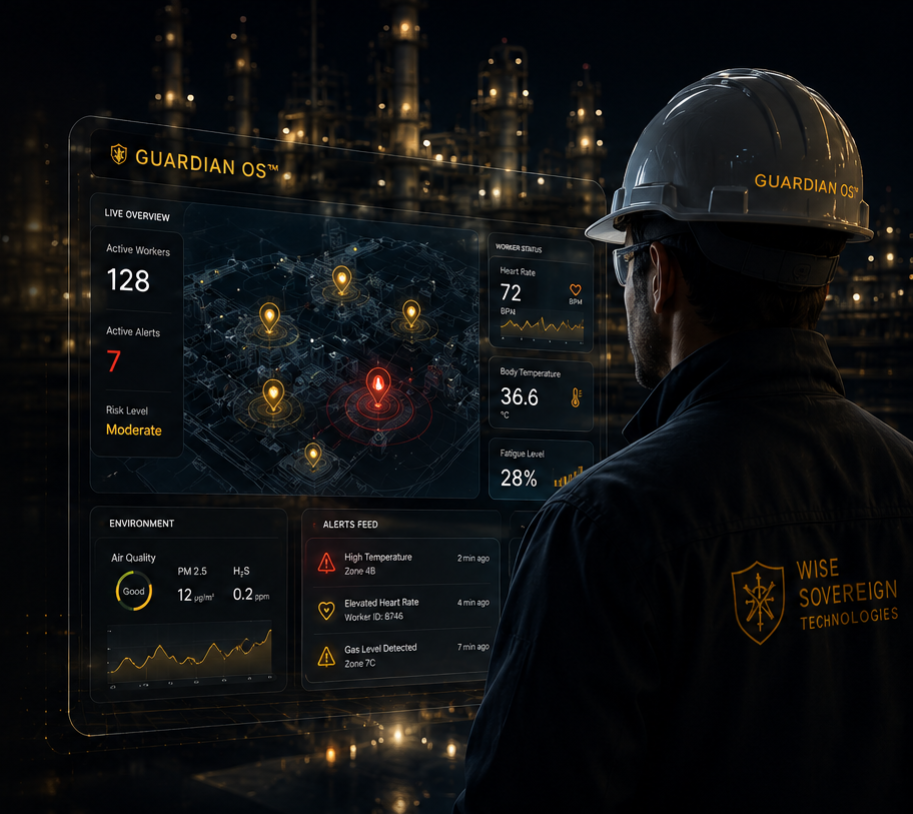
Guardian OS™
The Intelligence Behind Industrial Protection
What Is Guardian OS™?
Guardian OS™ is the central intelligence engine that powers the entire Guardian ecosystem.
It receives live biometric, atmospheric, motion, and location data from every worker, analyzes it in real time, and identifies risk patterns long before an emergency occurs.
Using a multi-layer architecture and AI-driven decision support, Guardian OS™ evaluates thresholds, interprets physiological trends, and triggers patented hands-free emergency communication the moment a critical condition is detected.
It is not a dashboard.
It is not an app.
It is the safety brain behind every worker wearing Guardian Industrial™.
The Royal Architecture of Guardian OS™
A sovereign AI architecture orchestrating industrial protection in real time.
Health Knight
Monitors raw biometrics, detects early physiological deviations, and ensures the worker's vital state is understood in real time.
Engineering Knight
Interprets motion, environmental stress, and operational telemetry to identify hazards before they escalate.
Security Knight
Guards the sovereignty of worker data, the integrity of the Guardian network, and the privacy of every transmission.
SAGE™
INTELLIGENCEFinance Knight
Translates safety into business intelligence: fatigue-productivity insights, craft-level analytics, and organizational reporting that aligns protection with performance.
Legal Knight
Ensures compliance, auditability, and the encrypted preservation of every event for liability protection and regulatory clarity.
Research Knight
Analyzes long-term patterns across deployments to advance the science of industrial safety.
From Observation to Intelligent Action
Guardian OS™ continuously observes biometric, environmental, and operational data streams. The Court of Specialized AI Knights analyzes incoming signals, identifies anomalies, predicts emerging risks, and escalates critical events before incidents occur.
OBSERVE
Collect biometric and environmental signals.
ANALYZE
Specialized Knights evaluate risk patterns.
PREDICT
SAGE™ forecasts potential incidents.
ESCALATE
Automated alerts activate response workflows.
Patented Hands-Free Emergency Escalation Engine
Guardian OS™ is the only industrial safety system with a U.S. patent covering automatic, hands-free, two-way supervisor-to-worker communication during emergency events.
When Guardian OS™ detects a critical threshold — such as physiological distress, overheating, motion irregularities, gas exposure, or collapse-risk patterns — the system instantly opens a direct communication channel with the worker.
No Manual Interaction
- No button press required
- No phone handling
- No user response needed
Real-Time Awareness
Supervisors gain immediate situational awareness: environment, worker condition, and urgency level in real time for instant decision-making.
Critical Impact
This capability removes minutes from emergency response time — and in industrial safety, minutes save lives.
Real-Time Physiological Intelligence
Live analysis of heart rate, temperature, motion, and environmental stress to detect early signs of heat exposure, fatigue, and collapse-risk conditions.
Automated, Hands-Free Escalation
Patented two-way emergency communication that connects supervisors to workers instantly when thresholds are breached.
Atmospheric & Gas Risk Integration
Combines biometric data with gas readings and environmental telemetry to evaluate hazardous exposure and trigger layered protection.
Enterprise Reporting & Insights
Guardian OS™ generates craft-level, project-level, and organization-level safety analytics for trend review, compliance, and decision-making.
Predictive Fatigue & Collapse Modeling
Machine intelligence forecasts risk hours before an event, enabling proactive intervention and improved crew rotation planning.
Sage and the Royal Knights
A distributed court of specialized AI agents — orchestrated by Sage, the Sovereign Intelligence — performing risk reasoning, hazard detection, and escalation logic across every domain of worker protection.